Because of the friction, some designers will pick a worm gear set to act seeing that a brake to prohibit reversing action in their mechanism. This notion develops from the concept that a worm gear set becomes self-locking when the lead angle is usually little and the coefficient of friction between the materials is huge. Although not an absolute, when the business lead angle of a worm equipment pair is less than 4 degrees and the coefficient of friction is usually greater than 0.07, a worm gear pair will self-lock.
Since worm gears have a business lead angle, they do create thrust loads. These thrust loads vary on the course of rotation of the worm and the way of the threads. A right-hand worm will pull the worm wheel toward itself if operated clockwise and will press the worm wheel away from itself if operated counter-clockwise. A left-hands worm will work in the precise opposite manner.Worm gear pairs are an excellent design choice if you want to reduce speeds and adjust the directions of your motion. They can be purchased in infinite ratios by changing the number of teeth on the worm wheel and, by changing the lead angle, you can modify for almost any center distance.
First, the basics. Worm gear sets are being used to transmit electric power between nonparallel, nonintersecting shafts, usually having a shaft position of 90 degrees, and contain a worm and the mating member, known as a worm wheel or worm gear. The worm has teeth wrapped around a cylinder, very similar to a screw thread. Worm gear pieces are generally used in applications where the speed reduction ratio is between 3:1 and 100:1, and in scenarios where accurate rotary indexing is required. The ratio of the worm established depends upon dividing the number of teeth in the worm wheel by the amount of worm threads.
The direction of rotation of the worm wheel depends upon the direction of rotation of the worm, and if the worm teeth are cut in a left-hand or right-hand direction. The palm of the helix may be the same for both mating participants. Worm gear units are made so that the one or both customers wrap partly around the other.
Single-enveloping worm gear sets include a cylindrical worm, with a throated equipment partly wrapped around the worm. Double-enveloping worm equipment sets have both people throated and covered around each other. Crossed axis helical gears are not throated, and so are sometimes referred to as non-enveloping worm gear models.
The worm teeth might have many different forms, and so are not standardized in the manner that parallel axis gearing is, but the worm wheel must have generated teeth to create conjugate action. One of the characteristics of a single-enveloping worm wheel is certainly that it is throated (see Figure 1) to increase the contact ratio between your worm and worm wheel tooth. This ensures that several tooth are in mesh, sharing the strain, at all instances. The effect is increased load ability with smoother operation.
Functioning, single-enveloping worm wheels have a line contact. As a tooth of the worm wheel passes through the mesh, the speak to collection sweeps across the complete width and height of the zone of actions. One of the attributes of worm gearing is that the teeth have an increased sliding velocity than spur or helical gears. In a low ratio worm gear establish, the sliding velocity exceeds the pitch line velocity of the worm. Although static capability of worms is high, in part because of the worm set’s great contact ratio, their operating capacity is limited because of the heat generated by the sliding tooth speak to action. Due to dress in that occurs therefore of the sliding actions, common factors between the number of the teeth in the worm wheel and the amount of threads in the worm should be avoided, if possible.
As a result of relatively excessive sliding velocities, the overall practice is 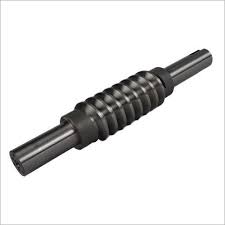 to produce the worm from a materials that is harder compared to the material selected for the worm wheel. Elements of dissimilar hardness will be less likely to gall. Mostly, the worm equipment set consists of a hardened metal worm meshing with a bronze worm wheel. Selecting the particular type of bronze is based upon consideration of the lubrication program used, and additional operating conditions. A bronze worm wheel is normally more ductile, with a lower coefficient of friction. For worm units operated at low quickness, or in high-temperature applications, cast iron may be used for the worm wheel. The worm undergoes many more contact tension cycles compared to the worm wheel, so it is beneficial to utilize the harder, more durable materials for the worm. A detailed examination of the application may indicate that different material combinations will perform satisfactorily.
Worm gear units are sometimes selected for employ when the application form requires irreversibility. This means that the worm cannot be driven by electrical power applied to the worm wheel. Irreversibility develops when the business lead angle is equal to or less than the static angle of friction. To prevent back-driving, it is generally essential to use a lead angle of no more than 5degrees. This characteristic is probably the causes that worm equipment drives are commonly used in hoisting devices. Irreversibility provides proper protection in the event of a power failure.
It is important that worm equipment housings always be accurately manufactured. Both the 90 degrees shaft position between the worm and worm wheel, and the guts distance between the shafts are critical, in order that the worm wheel tooth will wrap around the worm correctly to maintain the contact structure. Improper mounting conditions may create point, rather than line, speak to. The resulting high unit pressures may cause premature failure of the worm set.
How big is the worm teeth are generally specified regarding axial pitch. This can be the distance in one thread to the next, measured in the axial plane. When the shaft position is usually 90 degrees, the axial pitch of the worm and the circular pitch of the worm wheel happen to be equal. It is not uncommon for good pitch worm sets to have the size of one’s teeth specified regarding diametral pitch. The pressure angles used depend upon the business lead angles and must be large enough to avoid undercutting the worm wheel the teeth. To provide backlash, it really is customary to skinny the teeth of the worm, but not one’s teeth of the worm equipment.
The standard circular pitch and normal pressure angle of the worm and worm wheel must be the same. As a result of variety of tooth varieties for worm gearing, the common practice is to establish the sort of the worm pearly whites and develop tooling to produce worm wheel tooth having a conjugate profile. For this reason, worms or worm wheels having the same pitch, pressure position, and number of teeth aren’t necessarily interchangeable.
A worm gear assembly resembles an individual threaded screw that turns a modified spur gear with slightly angled and curved tooth. Worm gears can be fitted with either a right-, left-palm, or hollow output (drive) shaft. This right position gearing type is utilized when a big speed reduction or a huge torque increase is required in a limited amount of space. Physique 1 shows an individual thread (or single begin) worm and a forty tooth worm gear resulting in a 40:1 ratio. The ratio is equal to the quantity of gear tooth divided by the amount of starts/threads on the worm. A comparable spur gear establish with a ratio of 40:1 would require at least two stages of gearing. Worm gears can achieve ratios greater than 300:1.
Worms can become made with multiple threads/starts as shown in Number 2. The pitch of the thread remains continuous as the lead of the thread boosts. In these illustrations, the ratios relate with 40:1, 20:1, and 13.333:1 respectively.
Bodine-Gearmotor-Body 2- Worm GearsWorm gear sets can be self-locking: the worm may drive the apparatus, but as a result of inherent friction the gear cannot turn (back-drive) the worm. Typically only in ratios above 30:1. This self-locking actions is reduced with wear, and should never be used as the principal braking mechanism of the application.
The worm gear is often bronze and the worm is steel, or hardened metal. The bronze component is built to wear out prior to the worm since it is simpler to replace.
তৈলাক্তকরণ
Proper lubrication is particularly essential with a worm equipment arranged. While turning, the worm pushes against the load imposed on the worm equipment. This effects in sliding friction when compared with spur gearing that produces mostly rolling friction. The easiest way to reduce friction and metal-to-metal wear between the worm and worm equipment is to use a viscous, temperature compound equipment lubricant (ISO 400 to 1000) with additives. While they prolong existence and enhance efficiency, no lubricant additive can indefinitely stop or overcome sliding wear.
Enveloping Worm Gears
Bodine-Gearmotor-Enveloping-Worm-Gear-with-Contoured-TeethAn enveloping worm gear set is highly recommended for applications that require very accurate positioning, high efficiency, and nominal backlash. In the enveloping worm gear assembly, the contour of the gear the teeth, worm threads, or both are modified to improve its surface get in touch with. Enveloping worm gear units are less prevalent and more expensive to manufacture.
If you need even more information concerning Single Start Worm take a look at our site.